Every question your exam asks.
An engine that only serves four-option multiple choice cannot deliver most real exams. These are the formats ours serves today, counted from the live bank it runs on — and the two it does not serve yet.

Live today
11,899 questions in the bank
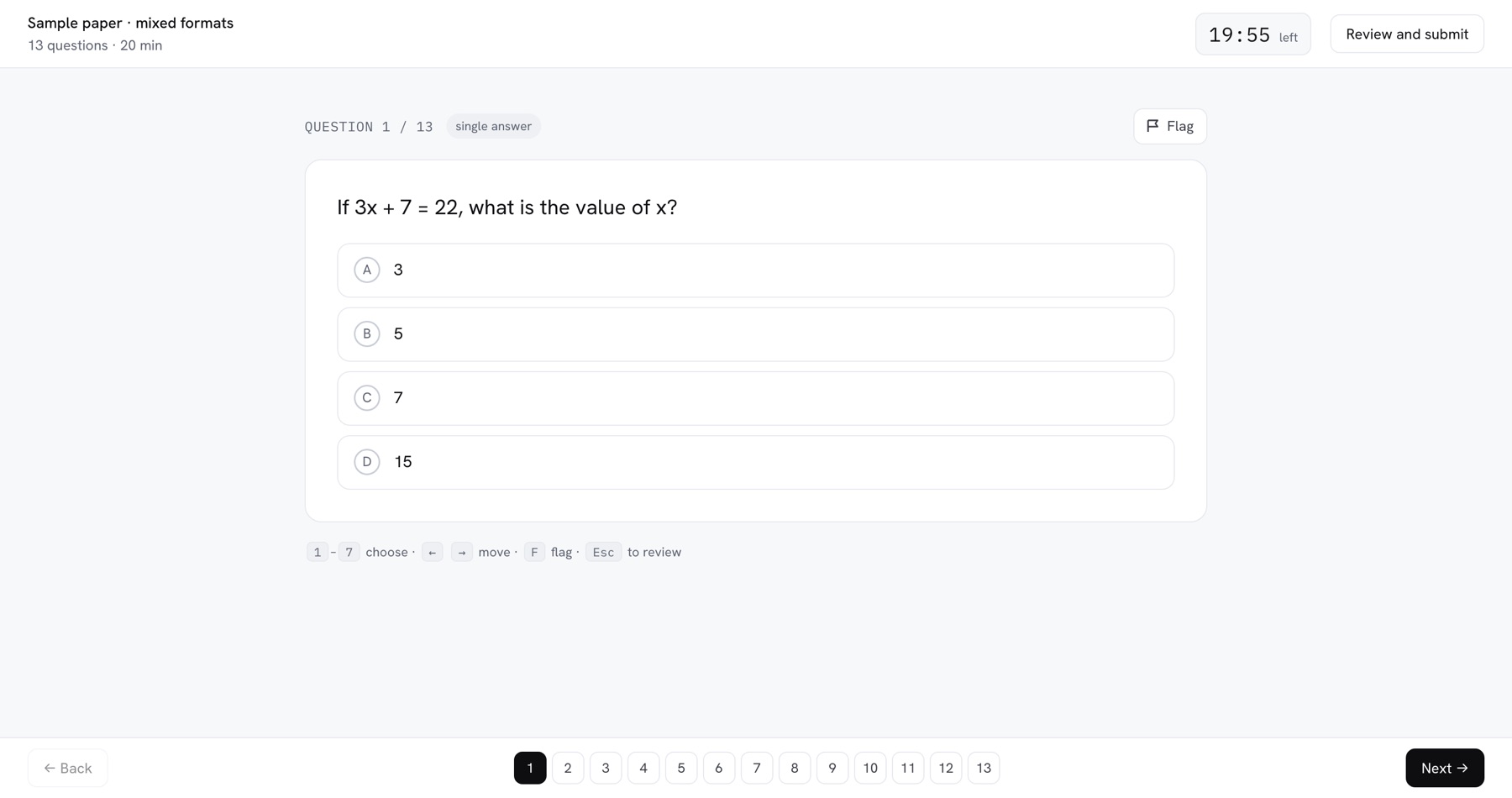
- Single choice8,178One correct option among four or five. The baseline every exam uses, and the one every engine can do.SAT · NMT · A-levels · IB
- Multiple response2,160Choose exactly three from seven. Partial credit, and a student who picks four gets nothing — so the interface has to count for them as they go.NMT · many national exams
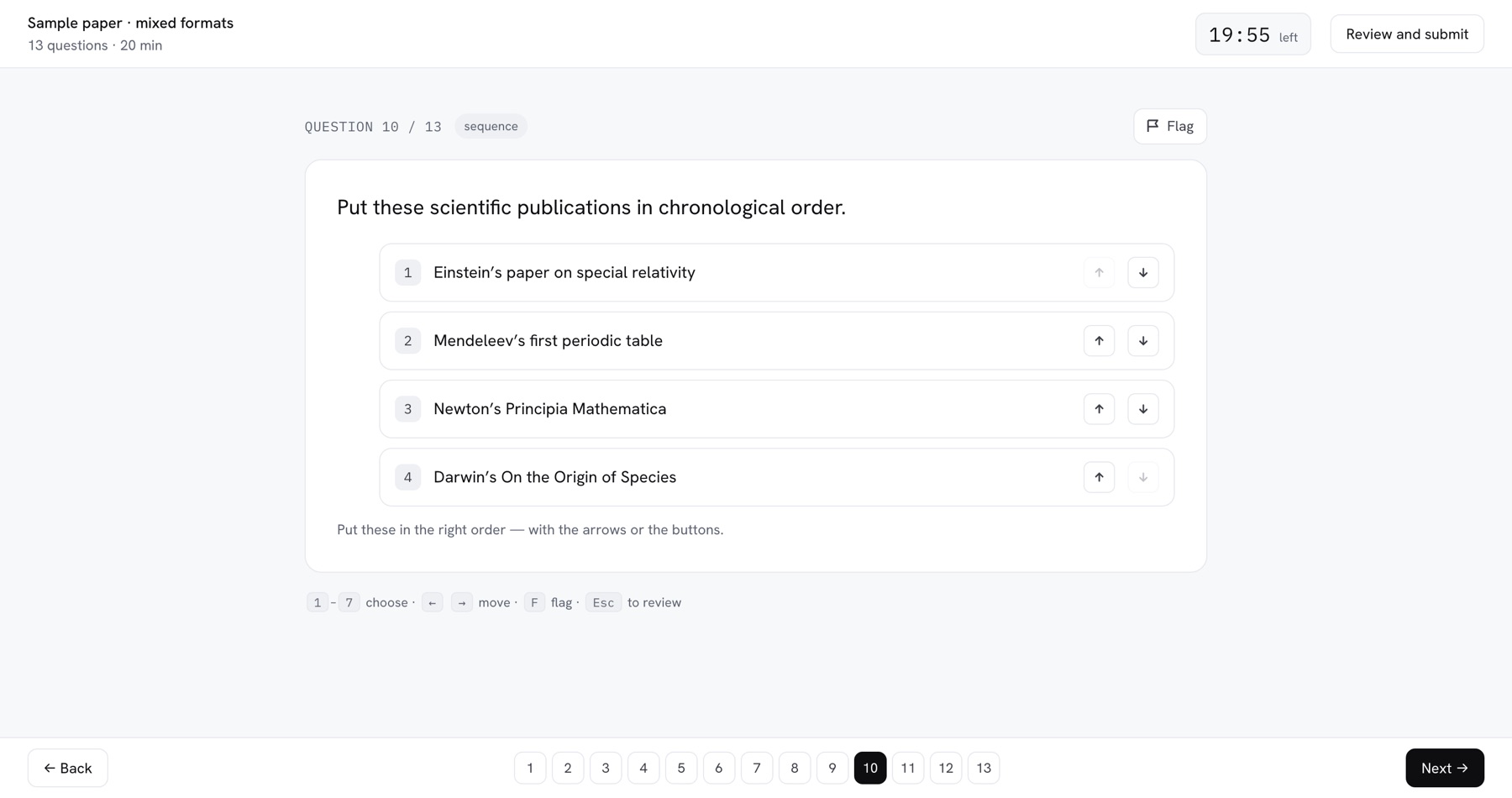
- Ordering848Put four events in sequence. Marked on the whole order, not on individual positions.NMT · history and science papers
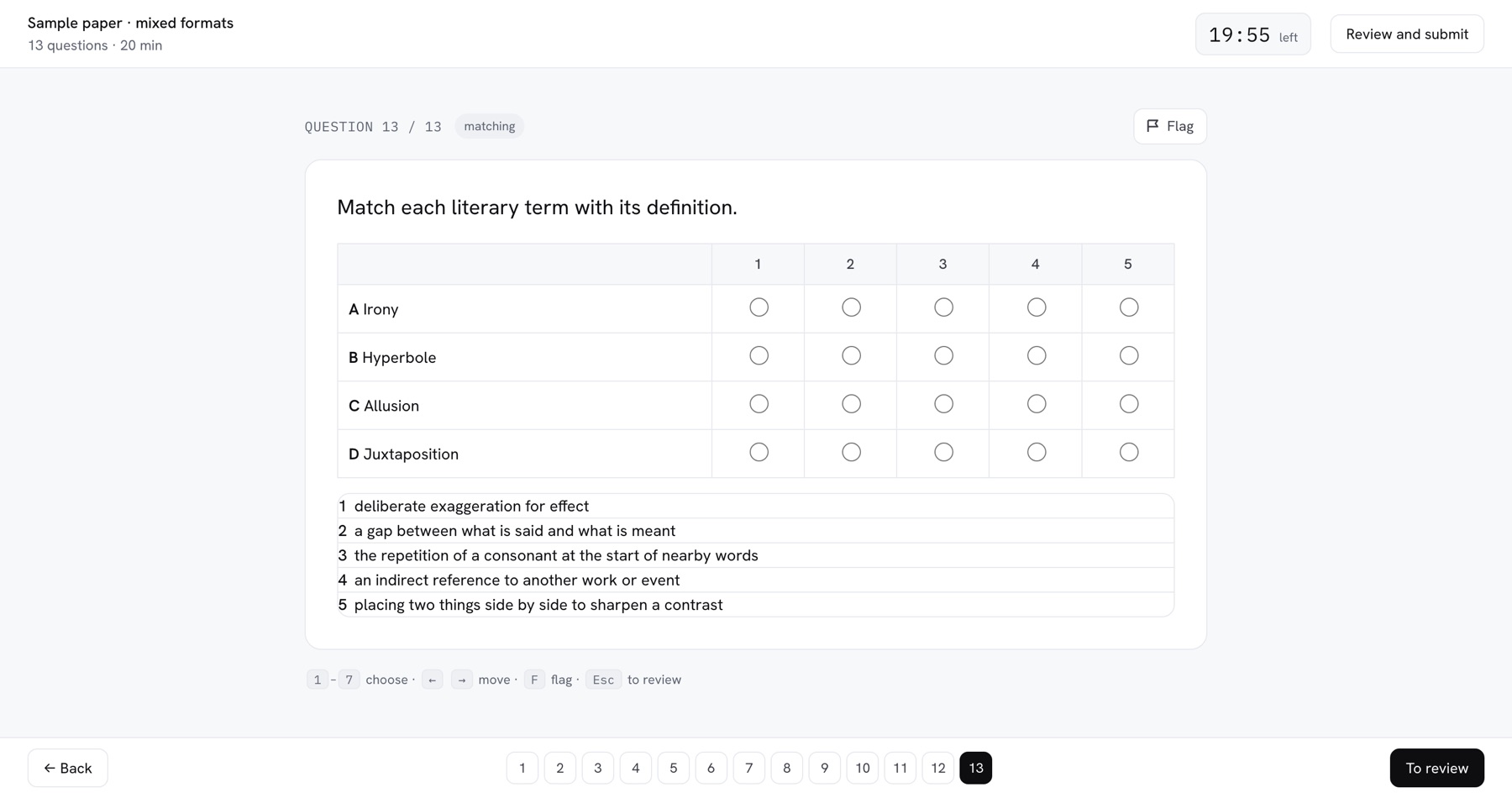
- Matching713Four items on the left against five on the right, one of which matches nothing. The distractor is the point of the format.NMT · language and humanities papers
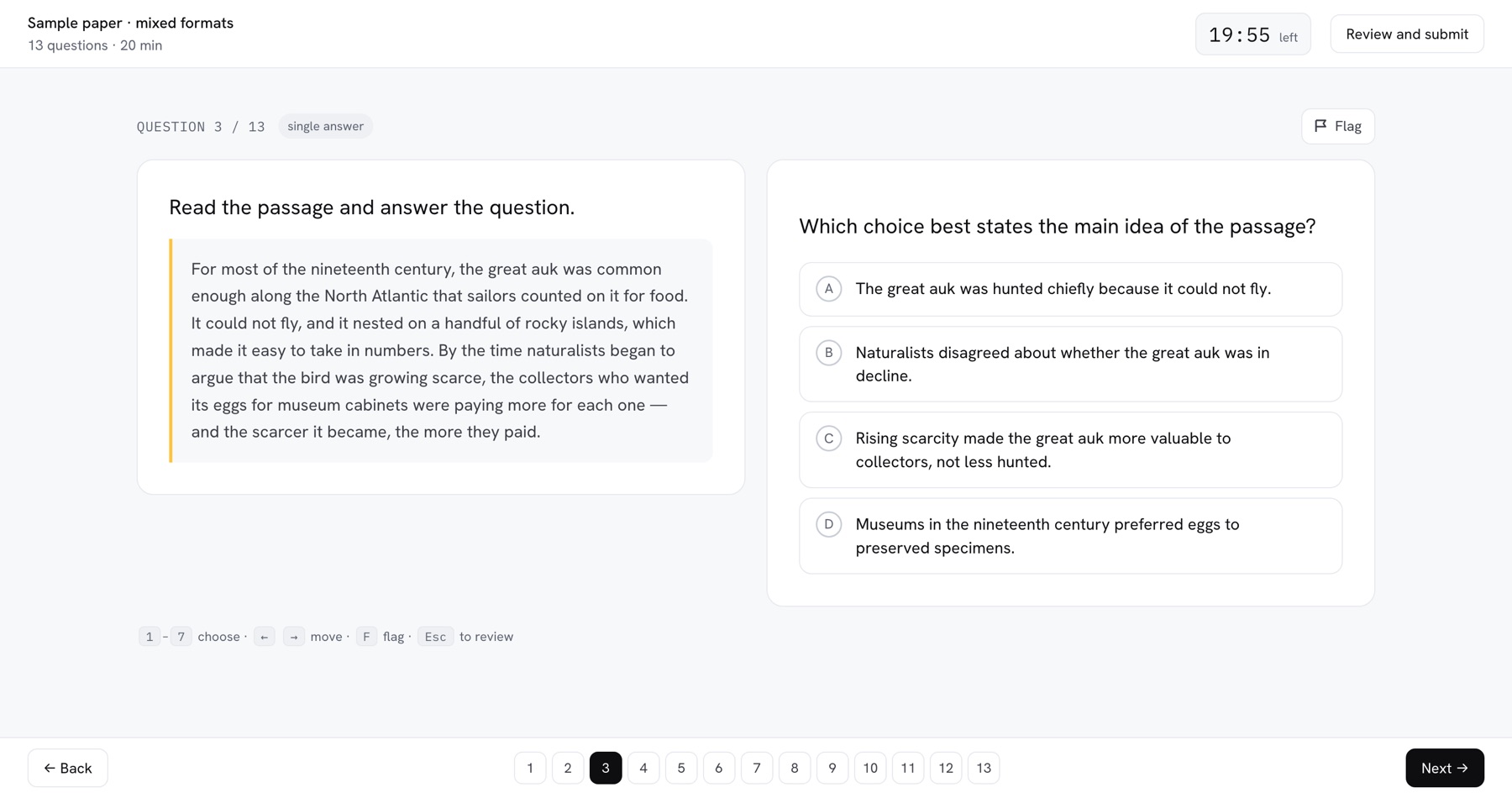
- Source-based—Not a format of its own but a layer on top of one: an excerpt, a map or a chart the question depends on. The source stays on screen beside the options rather than scrolling away.SAT Reading · NMT · history papers
Not yet
Named, not hidden
- Student-produced response—A number typed in rather than chosen — the SAT grid-in. Needs answer-equivalence rules (0.5 and 1/2 are the same answer) before it can be marked, which is why it is not live yet.SAT Math
- Extended written response—An essay or a long answer. We would rather not serve this than mark it badly: the engine measures what it can check, and a human still marks the writing.IB · A-levels · national language papers
The screens, as they are.
These are screenshots of the running engine, not mockups — but the paper in them is a sample we wrote to show the formats, so you can read it whatever subject you teach. No student has sat these questions, and none of them carries a difficulty figure. The counts above are the live bank; the screens below are the formats.
What delivery has to get right.
The clock never scrolls away
Time left and the question map stay pinned. A candidate checks both constantly, and hunting for them costs marks that have nothing to do with the subject.
Ruling an option out is part of answering
A student can strike through options they have eliminated. It is how people actually work multiple choice, and it is the tool candidates ask for most.
Nothing needs a mouse
Ordering moves with buttons rather than drag, every option takes a number key, and the whole paper is reachable by tab. Drag-only controls lock out keyboard users and fight the scroll on a phone.
Nobody submits blind
The review screen lists every question with its state and says how many are still empty before the paper can be handed in.
Difficulty is measured, not asserted
Each question carries the share of students who got it right on first contact, before any explanation. Where too few students have met a question, we say the difficulty is not measured yet rather than show a number we do not have.
Adding a format is work on the engine; adding an exam is mostly work on its question bank. If your exam asks something that is not on this page, tell us what it looks like — that answer is more useful to us than a feature request.
See Gaplight on your students' exam.
A walkthrough of the diagnostic, the plan and the teacher view, and a pilot plan sized to your school or center.